Model Weight Availability Coverage Use Case
Direct answer. Model weight availability coverage tests whether your brand is described differently across fixed vendor-hosted API endpoints, while disclosing public-weight availability only where it applies to specific model families or checkpoints.
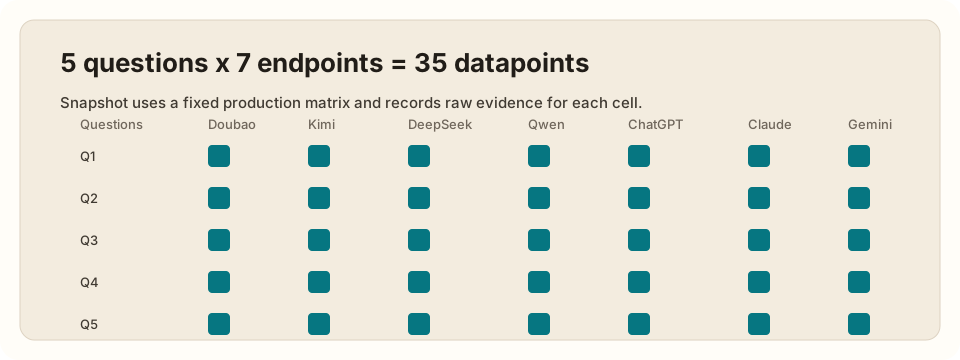
Current Snapshot endpoint mix
| Weight availability context | Endpoints in Snapshot | Why it matters |
|---|---|---|
| Public weights or public checkpoints exist for specific models | Kimi, DeepSeek, Qwen | DeepSeek and Qwen have public-weight model families; Kimi has specific public checkpoints such as Kimi K2. Exact API model id is disclosed per run. |
| No public production-weight claim by Clarivy | Doubao, ChatGPT, Grok, Claude, Gemini | Shows how other vendor-hosted API surfaces answer the same buyer questions. |
Good questions for model weight availability coverage
- Which brands solve [problem] for buyers in [category]?
- What are alternatives to [competitor] for [category]?
- Which [category] providers are suitable for regulated or procurement-heavy teams?
- What sources explain [brand] and its product accurately?
- How should a buyer compare [brand] with [competitor]?
FAQ
What does model weight availability coverage mean?
It means the audit measures fixed vendor-hosted API endpoints and discloses public-weight availability only where it applies to specific model families or checkpoints.
Does model weight availability describe language support?
No. All tested models are treated as multilingual endpoints. Review the methodology for the exact matrix.
What should I read next?
Read the model weight availability visibility audit page and the pricing page.