Model Weight Availability Visibility Audit
Why weight availability matters
Public weights can help technical teams reason about reproducibility, benchmarkability, and vendor lock-in. For an audit buyer, the useful question is narrower: which exact API model was measured, and whether public weights exist for the same model family or a related checkpoint.
Current Clarivy endpoint matrix
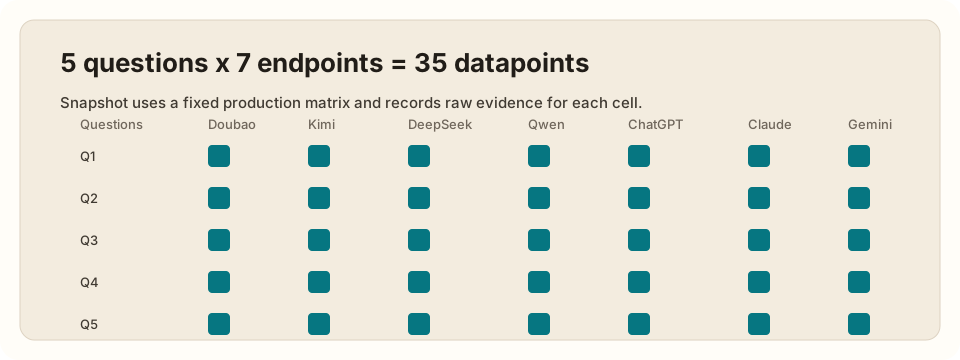
| Weight availability context | Endpoints in Snapshot | What Clarivy claims |
|---|---|---|
| Public weights or public checkpoints exist for specific models | Kimi, DeepSeek, Qwen | DeepSeek and Qwen have public-weight model families. Kimi has specific public checkpoints such as Kimi K2. Clarivy records the exact API model id per datapoint instead of claiming all Kimi API models are open-weight. |
| No public production-weight claim by Clarivy | Doubao, ChatGPT, Grok, Claude, Gemini | The audit calls vendor-hosted API surfaces and records model id, API method, and data-control status per datapoint. |
What the grouping does not mean
- It does not mean Clarivy self-hosts public-weight models; Snapshot calls reviewed vendor APIs.
- It does not mean a vendor's API model is identical to a public checkpoint unless the recorded model id proves it.
- It does not describe geography or language capability. All tested models are treated as multilingual endpoints.
- It does not add ERNIE, MetaSo, or Perplexity Sonar to the current production Snapshot matrix.
Use cases
- Procurement: show whether vendor claims are stable across fixed API endpoints with different public-weight availability contexts.
- Marketing: learn whether category and competitor prompts produce different brand visibility patterns by endpoint.
- Compliance: attach model id, API method, retention posture, and raw response evidence to every datapoint.
FAQ
Which endpoints have public-weight references?
DeepSeek and Qwen have public-weight model families. Kimi has specific public checkpoints such as Kimi K2. Clarivy records the exact API model id used in each customer run instead of claiming every Kimi API model is open-weight.
Does Clarivy self-host open-weight models?
No. Clarivy Snapshot measures vendor-hosted API endpoints. Public-weight availability is context, not a self-hosting claim.
Where is the endpoint list versioned?
The current production list is versioned on the Methodology page. Adding or removing an endpoint is a methodology change, not a marketing-only edit.